Reason and question
Propose hypotheses, choose supported methods, interpret evidence and identify uncertainties.

RESONALIS / J-EXPRESS
J-Express combines exploratory statistics, linked visualization and data management with the reasoning capabilities of modern AI models. Free to use, and built by enthusiasts with extensive AI assistance.
Open J-ExpressAI + J-EXPRESS / ARCHITECTURE
Modern AI models already bring powerful scientific knowledge and reasoning to research. J-Express does not compete with this expertise. It provides the data-management, computational and interactive analysis environment that an intelligent agent can use — with the researcher in control.
J-Express remains authoritative for datasets and exact numerical results. It owns original and derived matrices, transformations, selections, visualizations and analysis provenance. An AI assistant can interpret the user's question, suggest methods, request supported operations, critique results and formulate hypotheses. Language-model estimates must never replace statistical computation, and biological interpretations must distinguish evidence from hypotheses.
Large matrices stay where they are. A dataset can contain hundreds of millions of measurements, far beyond what should be transferred into an AI conversation. The intended workflow is iterative: request bounded metadata or statistics, compute locally, return a small structured result, and drill down only where more evidence is needed. Identifiers, annotations and summaries may still contain sensitive information and need appropriate disclosure controls.
Propose hypotheses, choose supported methods, interpret evidence and identify uncertainties.
Manage datasets, perform precise calculations, render views and preserve analysis provenance.
Approve sensitive operations, inspect computations, challenge conclusions and steer the analysis.
We have developed five research-informed scientific skill procedures covering matrix analysis, normalization, embeddings, bulk RNA-seq and single-cell RNA-seq. They translate published best practices into documented AI workflows, with explicit assumptions, quality checks and references. The real multiplier is not AI alone, but AI capabilities combined with these skills, reliable tools and the researcher’s own expertise. Inspect the scientific skills and whitepapers ↗
We envision two complementary layers. Tools provide the operational interface between an AI assistant and J-Express: inspect authorized datasets, request bounded statistics, run supported analyses and retrieve visualizations or structured results. The J-Express engine remains responsible for exact computation, authorization and provenance.
Scientific skills capture reusable, domain-aware workflows: which checks to perform before an analysis, how to choose appropriate normalization or statistical methods, what evidence to request and which pitfalls to avoid. Skills can guide the AI through steps such as bulk RNA-seq quality assessment, single-cell clustering and marker analysis, or exploring AI embeddings. They complement the model's reasoning rather than replacing it.
In practice, a skill helps the AI decide what to do and why; tools let it ask J-Express to do the computation and return evidence. The researcher can review decisions and guide the process. This combined architecture is a development direction: MCP tools already exist, while a coherent, validated scientific-skills library and broader agent workflows are planned.
External AI via MCP: a paired, authorized J-Express session exposes supported tools to an external assistant such as ChatGPT. Browser-local data cannot be assumed to exist on the MCP server; requests must reach the correct live session.
Future in-app AI: a model-provider adapter inside J-Express could use the same internal Analysis API. This is a separate proposed integration, with explicit requirements for credentials, consent, billing and data disclosure — not an available feature being advertised today.
The architecture calls for dataset-scoped authorization, separate read/write permissions and a dataset lock enabled by default. Updating existing numeric values requires an explicit user unlock. Proposed larger analysis operations should have validated parameters, bounded and paginated results, asynchronous job status, cancellation, and recorded inputs, versions and provenance. These are design requirements; their implementation varies by tool.
Current capability versus roadmap: J-Express already provides interactive exploration and an MCP connection with existing dataset and view operations. The whitepaper proposes a shared, versioned Analysis API, dedicated dataset and analysis summaries, safe structured queries, and validated long-running agent-operated analyses. These proposed endpoints should not be read as an inventory of deployed tools.
Read the technical whitepaper: AI-Assisted Scientific Analysis in J-Express ↗
J-EXPRESS / MODERN RNA-SEQ ANALYSIS
J-Express supports exploration of both bulk RNA-seq and single-cell RNA-seq datasets. Inspect high-dimensional patterns with PCA, heatmaps and hierarchical clustering, follow samples or cells across linked views, and investigate features that distinguish groups.
For bulk RNA-seq, explore count-based gene-by-sample datasets, sample quality and expression patterns. For single-cell RNA-seq, explore cell-level measurements, apply cell QC and filtering, visualize structure with UMAP, and investigate cell clusters and marker genes. Appropriate normalization and statistical interpretation depend on the dataset type; J-Express does not replace read alignment, quantification or dedicated RNA-seq count-based inference pipelines such as DESeq2/edgeR.
Open J-Express and choose a dataset from Demo (export any unsaved work first):
Working with your own data? Import a suitable count or expression matrix with sample or cell annotations, then choose quality control, normalization and exploratory analyses appropriate to bulk or single-cell RNA-seq.
J-EXPRESS / AI INTERPRETABILITY
AI models are becoming more capable, but understanding what happens inside them remains a major research challenge. Why does a model respond differently to similar inputs? Which internal representations change when unexpected behavior appears?
Resonalis aims to bring the exploratory strengths of J-Express to this problem: analyzing activation patterns, comparing groups of model runs and visualizing high-dimensional representations. These analyses may help researchers identify candidate features and formulate testable hypotheses about model behavior.
Finding correlations is not the same as establishing causes. Explaining why a model behaves a certain way also calls for model-aware experiments and causal intervention methods — directions for future research, rather than capabilities we claim to provide today.
Make the hidden structure of AI models easier to explore.
J-EXPRESS / A WORKFLOW FOR DISCOVERY
J-Express already lets researchers inspect multidimensional data through linked visualizations. We are extending these workflows to modern embeddings, while automated AI-agent analysis remains a research direction.
Import biological datasets, existing J-Express projects, numeric CSV/TSV matrices or embedding vectors. J-Express also includes real text-embedding demonstrations and optional browser-local MiniLM inference.
Use clustering, projections and linked visualizations to explore structure, outliers and meaningful differences.
Ask questions, evaluate proposed analyses and examine the evidence behind each finding. Some tool-mediated agent interactions are already supported through MCP; fully automated, validated analysis workflows remain a development goal.
Illustrative future workflow — not a claim that all AI integrations are available today.
J-EXPRESS / THE PLATFORM
J-Express is back as a browser-based data exploration workspace. For biological data it supports PCA, correspondence analysis, hierarchical clustering and heatmaps, self-organizing maps, measurement profiles, feature selection, and differential analysis including SAM where applicable. Already have datasets from the original J-Express? You can open your existing J-Express .pro project files in the new browser-based J-Express and continue exploring your data with both familiar and newer analysis tools. Projects can also be saved locally or exported as JSON.
J-Express also supports embedding datasets, UMAP, cosine nearest neighbors, semantic search, Concept Explorer and neighborhood-preservation analysis. A MiniLM text demo shows how sentences become numerical vectors; compatible new text can be embedded locally in the browser when model assets are available. These techniques help reveal relationships in representations; they do not, by themselves, explain the causal mechanisms of an AI model.
Biological analysis remains central. The external MCP connection already supports selected agent-operated interactions. A unified Analysis API, structured summaries and more extensive automated workflows remain under development.
J-Express is free to use. It is developed by enthusiasts who believe powerful exploratory analysis tools should be accessible, with extensive help from AI coding assistants and models.
We gratefully acknowledge ChatGPT by OpenAI, Claude by Anthropic, and Gemini by Google as important tools in its ongoing development. These acknowledgements recognize the tools we use, not sponsorship or endorsement by their creators.
J-EXPRESS / J-EXPRESS IN PRACTICE
J-Express brings linked visualizations and exploratory methods to biological datasets and high-dimensional representations from modern machine learning. Start with a demo, inspect structure and follow interesting observations across views.
BIOLOGICAL ANALYSIS
Inspect sample groups and features using PCA, correspondence analysis, clustering, heatmaps and feature selection. Work with existing J-Express projects and appropriately prepared biological matrices.
Explore biological demos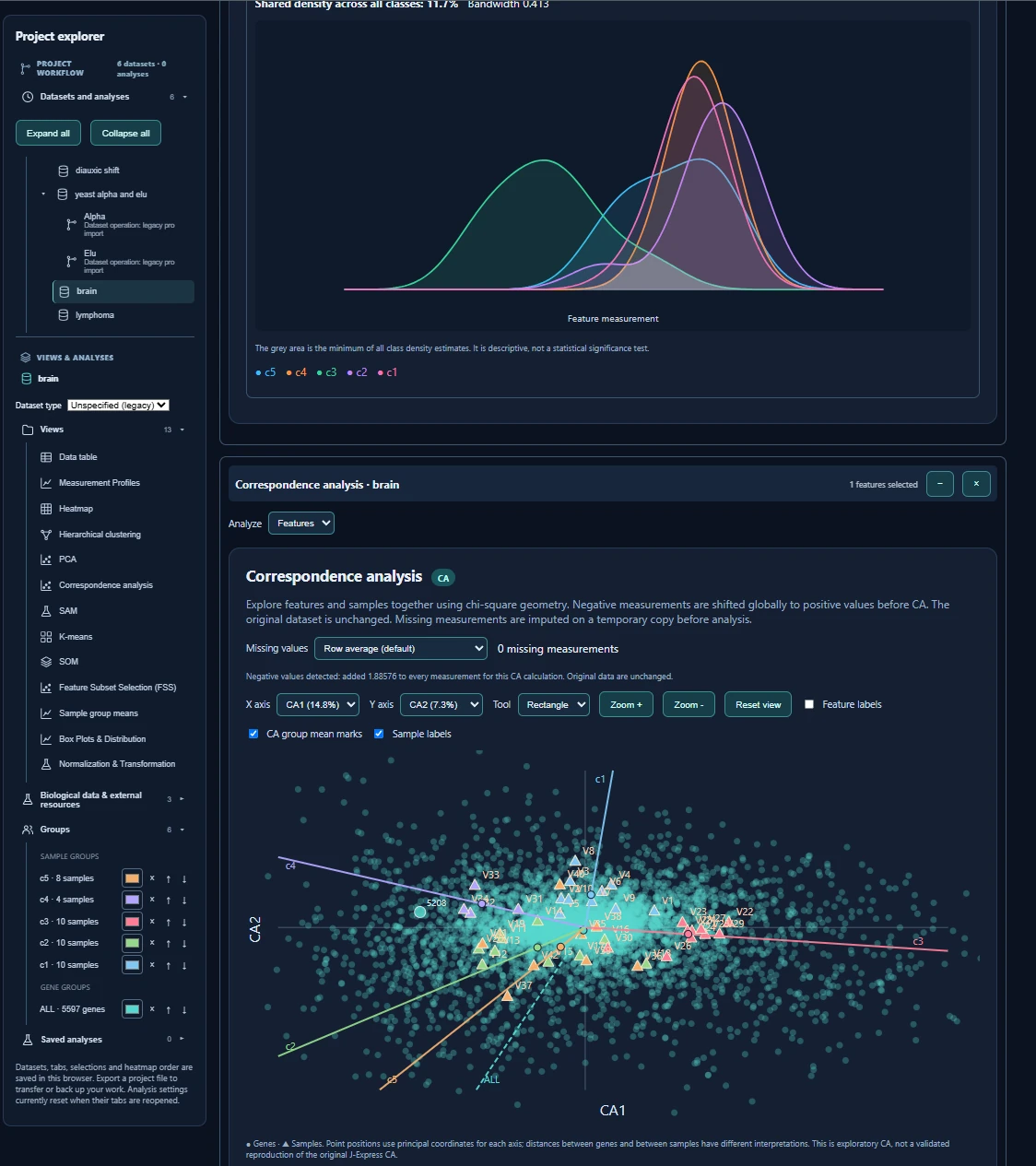
AI AND EMBEDDINGS
Explore text embeddings with UMAP, nearest-neighbor relationships, semantic search and concept-oriented views. Visualize similarity and group structure while keeping interpretations grounded in the data.
Explore embedding demos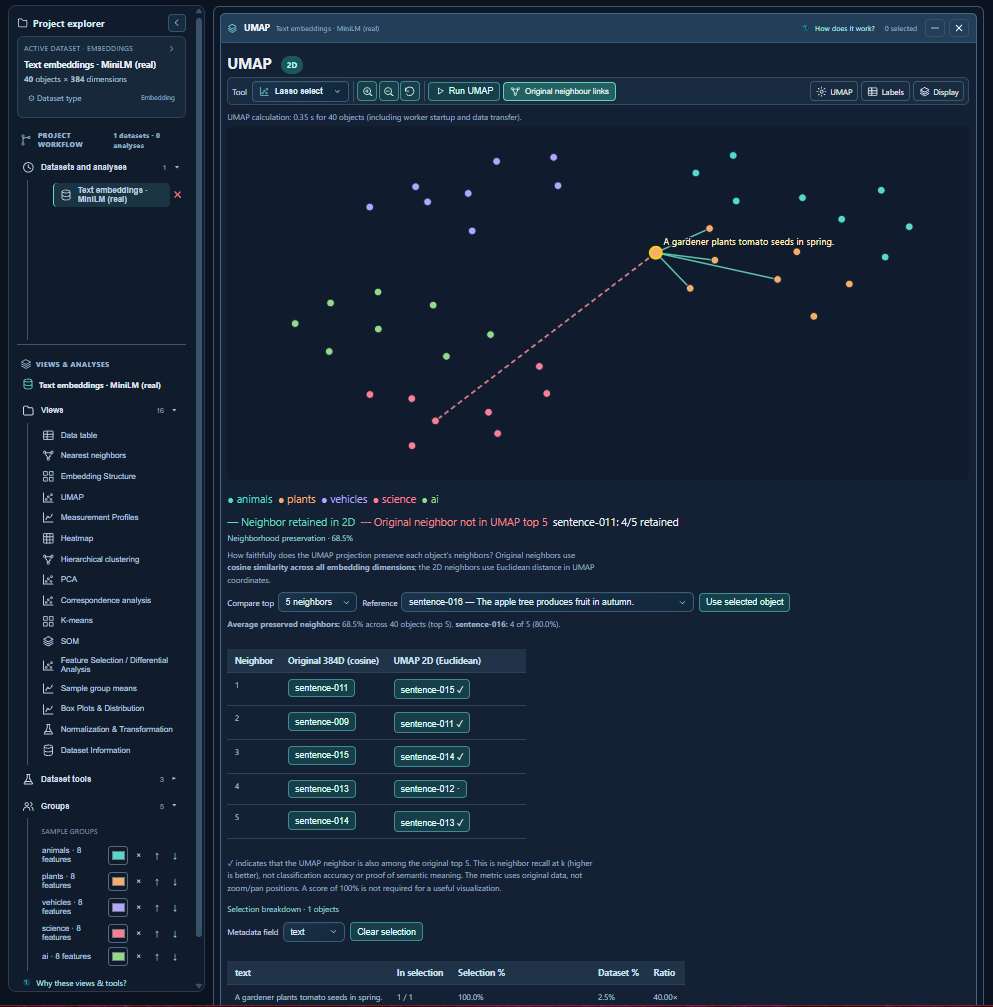
J-Express runs in the browser. Optional local text embedding may require downloading model assets. Similarity and projections alone do not establish causal explanations of AI behavior. MCP tool-mediated operations are available; the full agent-operated analysis workflow described in the whitepaper remains a roadmap.
J-EXPRESS / DELIVERIES & FUTURE PLANS
Explore delivered capabilities, ongoing work and proposed new data support — from proteomics and metabolomics to spatial omics, multimodal embeddings and sensor data.
Explore the J-Express roadmap ↗